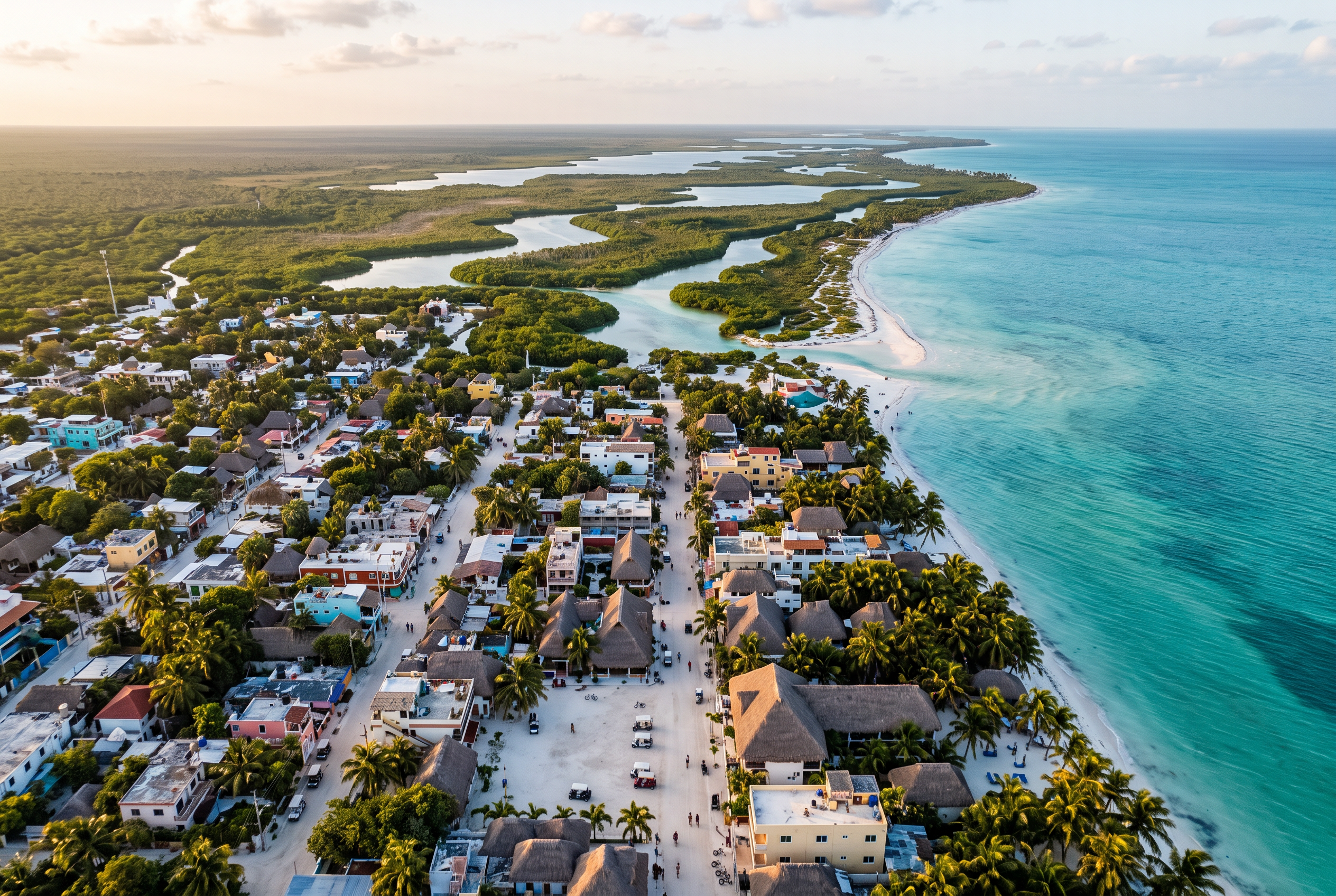
Development · What is proposed vs what is built
Holbox tourism growth: what's actually changing on the island (2026)
Honest look at Holbox tourism development: the 75% summer occupancy figure in context, the 1.5 billion peso infrastructure proposal, the ejidatario land-rights debate, and the Yum Balam rules behind the headlines. No "paradise lost" overcl aims; no "nothing to see here" either.
The short answer
Holbox’s tourism story is not just about how many rooms were booked. It’s about the services that support those rooms, the protected landscapes around them, and who gets a say in what happens next.
The reporting shows four connected conversations: strong summer demand, an attributed-but-unfunded infrastructure proposal, a community land-rights debate on Isla Grande, and new environmental-management initiatives whose results are mostly still “announced” rather than “measured.” A simple contest between developers and environmentalists misses most of what’s actually happening.
What the demand figures actually show
A September 21 2026 report from Quintana Roo Hoy quoted Christian Stenta, president of Holbox’s hotel association, saying summer occupancy averaged about 75 percent, with peaks reaching 90 percent during some August weeks. Those two numbers tell different parts of the story.
What they establish:
- Strong demand during parts of the summer.
- Enough variation across weeks to make “everything is full all summer” wrong.
What they don’t establish:
- An all-time tourism record. That would need consistent year-over-year figures with comparable hotel coverage.
- A total visitor count. Hotel occupancy doesn’t measure day-trippers, ferry passengers, or residents.
- A carrying-capacity breach. 90% occupancy says nothing directly about wastewater design capacity.
The same report expected a quieter period through mid-October and the next high season from November. A separate September 7 report forecast September occupancy at 35–40%. That was a forecast, not the measured result — and 35% occupancy isn’t the same as a 35% decline. See How busy is Holbox? for the full occupancy-interpretation guide.
The 1.5 billion peso proposal
In April 2026 reporting from Riviera Maya News, Mayor Nivardo Mena Villanueva said Holbox needed at least 1,500,000,000 Mexican pesos (not US dollars) for a comprehensive drainage and wastewater-management project. The same report said the proposal had been presented to Conagua and that no implementation date was set at that time.
Three things to keep straight:
- Pesos, not dollars. At late-2026 rates, 1.5 billion MXN is roughly 75–85 million USD — still a major investment proposal, nowhere near a US-billion-dollar project.
- A proposal is not an approved budget. We haven’t found a document establishing that the full scheme has been funded, awarded to a contractor, or started construction.
- The attributed cause is accelerated growth outpacing existing wastewater handling. That is a political framing from the mayor, not an independent capacity measurement.
For the fuller timeline and what’s still unverified about this proposal, see Holbox water and sewage.
The ejidatario debate
October 2026 reporting from Grupo Animal (Verónica Fajardo) described ejidatarios — local communal landholders — seeking a greater role in decisions over their land and adjustments allowing what they described as low-impact tourism development on Isla Grande. Community representatives were quoted arguing that conservation and local economic opportunity should work together.
A few important nuances the dossier flagged:
- These are attributed community views, not a unanimous survey of every resident. Some ejidatarios may want different things.
- The article says it did not receive an institutional response from CONANP (Mexico’s protected-areas commission). That’s the publisher’s reporting — not an unanswered request from us.
- The article distinguishes the heavily developed inhabited town from more restricted Isla Grande. The two have different legal regimes.
What this isn’t: proof that every resident supports more development, nor proof that every ejidatario opposes conservation. The real story is a specific group asking for a specific role in specific decisions.
Yum Balam: not every rule everywhere
The Yum Balam protected area’s management framework divides the island and surrounding waters into subzones with different permitted uses — preservation, sustainable use, settlement, recovery. A rule applying to a Punta Mosquito preservation subzone is not automatically the rule for the town centre.
That matters when people argue about development. A proposed project still needs the authorizations relevant to its specific location and activity. “All construction on Holbox is banned” and “anything goes” are both wrong. The full subzone breakdown is in the Yum Balam guide.
Announced vs built
In June 2026, Quintana Roo state presented Holbox as a pilot for a circular-economy strategy. The announcement listed measures including a planned biodigester (one tonne of organic waste weekly) and 24 solar panels. PetStar separately described the opening of its transfer centre for recyclable materials.
These need separate labels:
Announced vs operating (as of October 2026)
- Operating
- PetStar transfer centre on Holbox — opened June 2026. Programme reports cumulative recovery of 6M+ PET bottles and 20+ cleanup days since 2024.
- Announced / planned
- One-tonne-weekly organic biodigester, 24 solar panels, broader zero-single-use-plastic goals. Not confirmed as installed/operating.
- Operator attribution
- Programme results are first-party cumulative claims from PetStar, not independent audits.
- Not verified
- Public visitor drop-off hours, exact map pin, item-by-item acceptance list.
For the full recycling picture and what visitors can actually drop off, see Recycling on Holbox.
What a traveller can actually do
None of this makes a visitor the swing vote on Holbox’s infrastructure. But there are small things that compound:
- Ask your accommodation how it handles water interruptions, what recycling system it participates in, and whether its wildlife-activity partners follow Yum Balam rules.
- Pick operators that mention their authorization for whale shark, kayak, and 3-islands tours — not just the ones with the best Instagram grid. See the wildlife rules guide.
- Reduce packaging you bring in. A refillable water bottle, a cloth tote, and a reef-safe sunscreen in a non-mini bottle together make more difference than any single hotel decision.
- Tip generously. The services under discussion are also the jobs of the people serving your breakfast.
- Don’t amplify unverified claims. Travel content shaming individual hotels or declaring the island “ruined” without evidence is a lazy genre. Specific, dated reporting beats vibes.
Sources and limits
This article draws on:
- Quintana Roo Hoy / Ángel Canul, September 21 2026 — 75% summer occupancy and association statements.
- Riviera Maya News, April 9 2026 — the 1.5 billion peso drainage proposal.
- Grupo Animal / Verónica Fajardo, October 1 2026 — ejidatario autonomy reporting.
- SEMARNAT / FAOLEX Yum Balam management summary (2018).
- Quintana Roo state communications office, June 2026 — Holbox Circular pilot announcement.
- PetStar, June 17 2026 — transfer centre inauguration and programme figures.
What this article is not:
- Not a long-term tourism growth series. Only one summer’s occupancy data was reviewed.
- Not an engineering assessment of Holbox’s wastewater system.
- Not an independent survey of residents’ views on development.
- Not an endorsement of or allegation against any individual hotel.
- Not a definitive account of the Biocentro Isla Grande decision — that story is held pending full ruling publication.
For related reading: Yum Balam explained, water and sewage, recycling, how busy is Holbox.
Frequently asked questions
Is Holbox over-touristed?expand_more
The reporting shows strong summer demand (~75% average hotel occupancy, with 90% peaks in some August weeks per 2026 reporting) and infrastructure under pressure. That is not the same as an "all-time record" or a verified ecological-capacity breach. Call it high summer demand, not a tourism collapse story.
Who said Holbox needs 1.5 billion pesos?expand_more
Mayor Nivardo Mena Villanueva, in April 2026 reporting. He said at least 1.5 billion Mexican pesos (not US dollars) was needed for a comprehensive drainage and wastewater-management project. The report said no implementation date was set at that time. It is a proposal, not a confirmed, funded, or awarded contract. See the water-and-sewage guide for the full chronology.
Are new hotels still being approved on Holbox?expand_more
Approvals happen within the Yum Balam management framework and SEMARNAT environmental impact review. One high-profile case (Biocentro Isla Grande) saw a 49-palafito proposal filed in 2024 and was later reported as refused in 2026 — the full ruling has not been published, so we don't currently cover that case as a definitive story. Treat each project individually; don't generalize.
What are ejidatarios asking for?expand_more
Per October 2026 reporting from Grupo Animal / Verónica Fajardo, ejidatarios (local communal landholders) were seeking a greater role in land-use decisions and adjustments allowing what they described as "low-impact tourism development" on Isla Grande. Those are attributed views, not a unanimous survey of the entire island's residents.
Did Holbox start recycling in 2026?expand_more
A PetStar-operated transfer centre inaugurated in June 2026 under the "Holbox Circular" programme, which the operator says began in 2024. Some circular-economy measures (biodigester, 24 solar panels) were announced as plans, not confirmed installations. See the recycling guide for what's been verified.
Should I feel bad for visiting Holbox?expand_more
No, but travel thoughtfully. The infrastructure concerns reporting raises are structural — they aren't fixed by cancelling a trip, and tourism revenue is also what funds the services under discussion. Ask hotels about recycling and water practices, pick operators that follow Yum Balam rules, don't collect wildlife, and tip local workers well.
What is Isla Grande?expand_more
Isla Grande refers to a larger, more restricted portion of the Yum Balam protected area adjacent to the inhabited Holbox town. Development restrictions there are tighter than in the town zone. The Biocentro Isla Grande project filing referred to a 49-palafito stilted-structure proposal in that area.
Keep reading
Conservation · The reserve behind the tours
Yum Balam and Holbox: why the protected area actually matters (2026)
The honest guide to Yum Balam — the 154,052-hectare Area de Protección de Flora y Fauna around Holbox. Correct legal category, subzones in plain language, what visitor rules actually exist, and the operator-authorization checks that matter.
Infrastructure · What is confirmed, what is not
Holbox water and sewage: what visitors should actually know (2026)
Honest look at Holbox water and sewage: the 1.5 billion peso drainage proposal, March 2026 aqueduct repair, drinking-water precautions, and the specific questions to ask your accommodation before you book.
Sustainability · Programme vs practical steps
Recycling on Holbox: what visitors can actually recycle (2026)
Honest guide to recycling on Holbox: what the PetStar transfer centre and Holbox Circular programme actually do, what's announced vs operating, and the practical steps for visitors — without inventing a drop-off map.
Seasons · Interpreting the occupancy numbers
How busy is Holbox? Understanding hotel occupancy and crowds (2026)
Honest answer to "is Holbox crowded?" — what the 75% summer average and 90% August peaks actually mean, what hotel occupancy does and doesn't measure, and the right booking questions to ask when choosing dates.
Every guide is grounded in our verified Holbox directory and free public data feeds (Open-Meteo weather, SunCalc moon, OpenStreetMap, Google Places). Updated October 20, 2026. Independent — no paid placements in article body.