Conservation · Observation over interaction
Wildlife on Holbox: what visitors should leave alone (2026)
Honest guide to Holbox wildlife rules: the April 2026 conch and starfish enforcement incident, what Yum Balam preservation rules actually prohibit, how whale shark operator authorization works, and why shells and starfish are a careful-not-casual answer.
The short answer
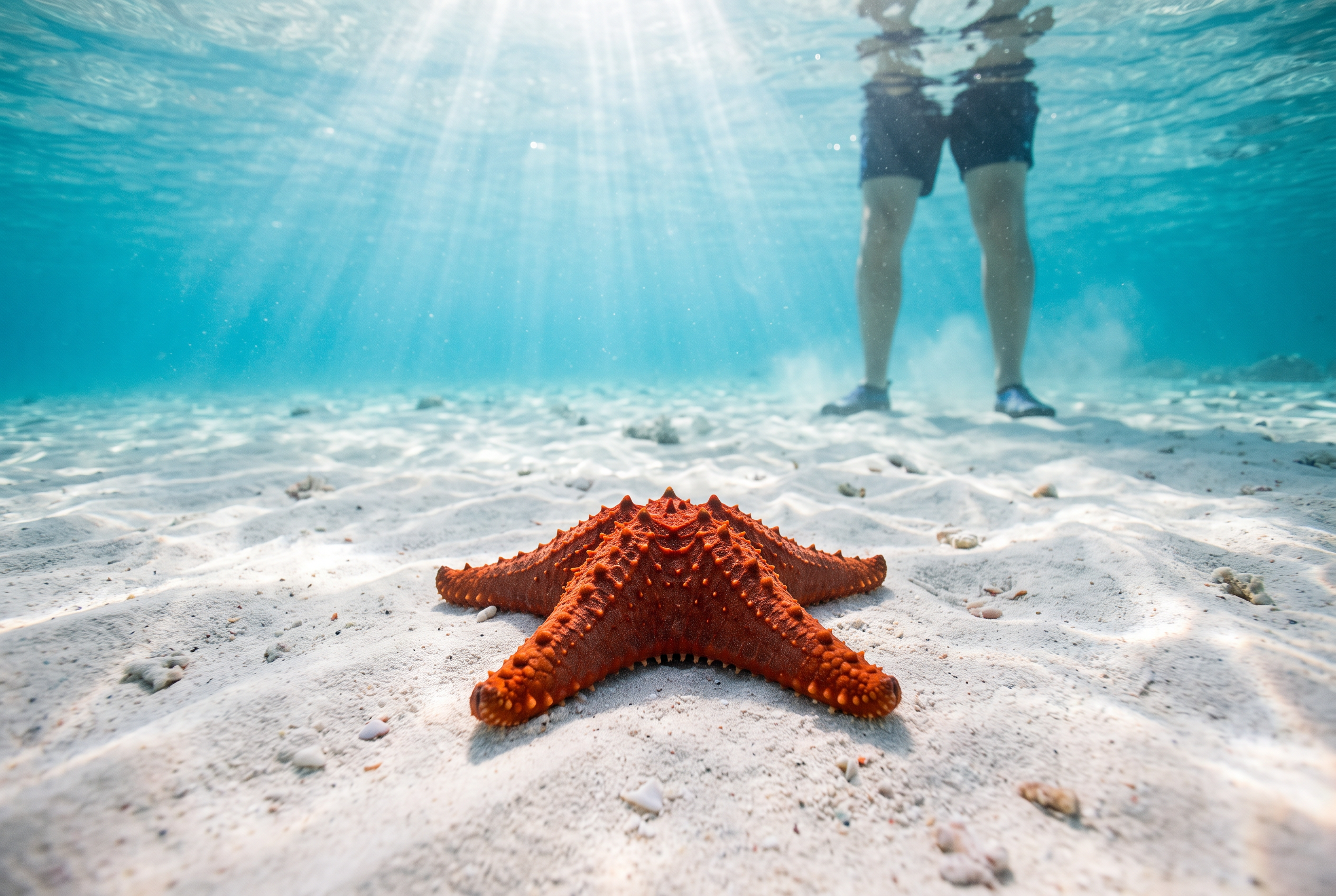
Finding wildlife on Holbox doesn’t mean it needs to be picked up for a better photo. The simplest visitor approach: observe, keep your distance, leave animals where they are.
That isn’t a vague eco-platitude. Specific rules apply in specific places, specific permits exist for specific activities, and specific enforcement actions have happened recently. Below is what the evidence actually supports — and what it doesn’t.
The April 2026 enforcement incident
A report indexed in April 2026 (Riviera Maya News) described Navy personnel and CONAPESCA (Mexico’s fisheries commission) finding 14 live queen conch and one live starfish during an inspection near Playa Azul. The person involved was reportedly diving from a kayak without the required fishing permits.
What happened:
- The animals were returned to the sea alive.
- The kayak and fishing gear were impounded.
- The agencies involved were the Navy and CONAPESCA — not PROFEPA (Mexico’s environmental enforcement body), despite how some retellings describe it.
What the incident does NOT establish:
- A general legal exemption for “small catches” or “just one shell.”
- A pattern of tourists being searched for souvenirs. (The person was reportedly diving, not walking along the shore with a tote bag.)
- A conviction. The report describes an enforcement action, not a court outcome.
It does show that fishing-permit enforcement happens, and that assumptions like “a small animal is automatically allowed” can be expensive.
What Yum Balam rules actually say
The Yum Balam management summary contains specific protections for its habitats. In the preservation sections reviewed for Punta Mosquito and Isla Grande beaches:
- Feeding wildlife is prohibited.
- Disruptive noise is prohibited.
- Interference with feeding, nesting, refuge, or breeding sites is prohibited.
- Vehicles on these beaches are restricted, with specified management-and-conservation exceptions.
These are rules tied to specific preservation subzones. Don’t generalize them as universal penalties applying to every square metre of the island — that mistake makes the real rules less credible. See the Yum Balam guide for how the subzone system works.
The practical visitor conduct that holds up in every subzone:
- Don’t feed animals — ever, including bread for seagulls or scraps for the island dogs.
- Don’t stage photos by handling wildlife. “Just a quick picture” is where it starts.
- Follow signs and designated routes.
- Keep distance from nesting beaches (May–October for turtle nesting at Punta Mosquito).
- Keep noise down near wildlife observation points.
Whale sharks, kayak tours, and authorization
Nature tours have their own authorization framework. The official whale shark management plan covering the 2025, 2026, and 2027 seasons requires operators to apply for authorization each season and allows the plan to be updated. Observation is distinguished from extractive use.
Three practical questions to ask any wildlife tour operator before you pay:
- “What authorization do you hold for this activity this season?” A specific permit scheme or number beats “we’ve been doing this for years.”
- “Which protected areas does the trip enter?” Whale shark trips often cross multiple protected-area frameworks (Yum Balam APFF, the whale shark biosphere reserve, the broader northern Mexican Caribbean biosphere reserve). A good operator can explain this.
- “What are the conduct rules for guests on the tour?” No sunscreen in the water; no touching; limited time per interaction. An operator that says “no rules, just have fun” is skipping the authorization.
A conservation logo or an attractive booking page is not the same as checking a permit. See the whale shark guide for season dates and operator selection.
Shells, starfish, and the souvenir question
Shells and souvenirs are where the clearest “yes/no” answers break down. The research for this article did not resolve all collection-and-international-transport rules for every shell a visitor might find or buy.
What we know:
Shell / starfish / wildlife-souvenir rules — stacked risks
- Yum Balam preservation subzones
- Prohibit disturbance of wildlife and refuge sites. Removing live organisms is clearly prohibited. Removing dead organisms is referenced in a later management-summary passage we didn't fully inspect — treat as prohibited by default.
- Live starfish
- Do not handle. Air exposure stresses the animal; your fingers may damage the delicate surface. Returning it incorrectly can kill it.
- Queen conch
- Regulated under Mexican fisheries law. The April 2026 enforcement incident shows how fisheries-permit violations are handled.
- Empty shells to take home
- Even where protected-area rules may not catch an empty shell, destination-country customs and CITES rules can. US and EU customs seize shells and marine products from protected species. 'Just a souvenir' is where the trouble starts.
- Shells bought from a shop
- A shop receipt does not guarantee lawful origin or lawful import at your border. CITES-listed species need documentation.
The safest visitor approach:
- Leave shells and natural objects on the beach where you found them.
- If you want a souvenir, choose a photograph, an artisan print, or a textile — something whose lawful origin is clear.
- Don’t buy a shell or dried animal product from a street vendor without knowing the species and both countries’ rules.
If you see something wrong
If you see an injured animal or suspected illegal activity, don’t attempt a rescue, move wildlife, or confront someone on the strength of a travel article.
- Note the location, time, and what you observed. A photo of a situation (not the animal being handled) can help.
- Report through official channels. CONANP for protected-area breaches; PROFEPA for environmental enforcement; CONAPESCA for fisheries violations. Your accommodation can usually route this.
- Don’t public-shame a specific person on social media. Counterproductive, risks defamation, and often targets a tour guide who doesn’t set the policy.
Sources and limits
- Riviera Maya News, April 2026 — “Conch and starfish enforcement” near Playa Azul.
- SEMARNAT / FAOLEX Yum Balam management summary (2018).
- CONANP Yum Balam management programme (historical instrument; detailed search extracts only).
- SEMARNAT / DGVS whale shark management plan 2025–2027 (April 2025).
What this article is not:
- Not a definitive legal FAQ on shell-collection rules, dead-vs-live distinctions, or international customs permissions.
- Not an “allowed handling time” for starfish or other animals (there isn’t a safe one).
- Not a fine or criminal-penalty schedule.
- Not a list of specific operators with or without authorization.
- Not an assertion that every tourist is being searched. The April incident involved a diver and a kayak, not a beachcomber.
For related reading: Yum Balam explained, whale shark season, Punta Mosquito, bioluminescence.
Frequently asked questions
Can I pick up shells on Holbox?expand_more
The careful answer: don't, by default. This guide did not resolve every collection-and-international-transport rule for every shell on every beach. Yum Balam preservation subzones specifically prohibit disturbing wildlife and refuge sites. Even where picking up an empty shell might not trigger an enforcement action, it can still breach a protected-area rule or a customs rule when you cross a border. Leave shells on the beach, buy a photograph instead.
Can I touch a starfish?expand_more
No, as a general rule — and specifically no in Yum Balam preservation subzones. Lifting a starfish out of water, holding it for a photo, or returning it incorrectly can injure or kill the animal. The April 2026 incident near Playa Azul involved a live starfish and 14 live queen conch; the person was reported to have been diving from a kayak without the required fishing permits. Don't make the animal part of your photo shoot.
What are queen conch and why do they matter?expand_more
Queen conch (caracol rosado) is a large marine snail with a pink-interior shell, slow-growing and heavily overfished across the Caribbean. Mexican fisheries law regulates when and where conch can be taken. The April 2026 Playa Azul incident reportedly involved 14 live conch found with a diver who lacked the required fishing permits. The animals were released alive; the kayak and gear were impounded.
Can my tour guide collect wildlife for me?expand_more
A guide's permission is not a legal clearance. Specific tourism activities within Yum Balam need relevant authorizations tied to the activity, species, subzone, and operator. "The guide said it was OK" is not a defense that holds up at an inspection — the guide is the one who'll lose their gear, as the April Playa Azul incident shows.
What about whale shark tours? Those are legal?expand_more
Yes, under the official whale shark management plan covering 2025, 2026, and 2027. Operators must apply for authorization each season. Observation is distinguished from extractive use. The plan can be updated. Ask the operator what current-season authorization they hold before booking — see the whale shark guide for details.
Can I keep a dead starfish or an empty shell I find on the beach?expand_more
Still answer: don't by default, and do not assume dead-vs-live changes the answer. Yum Balam preservation sections reference prohibitions on removing live or dead organisms in a later passage of the management summary — we did not fully inspect the surrounding rule, so we won't promote the snippet into a universal visitor offence. BUT: shells leaving Mexico can also hit CITES and customs rules. The combined risk makes "leave it" the safe choice.
What if I see illegal wildlife activity on my tour?expand_more
Do not try a rescue, do not relocate wildlife, and do not confront someone on the strength of a travel article. Note the location, time, and what you observed. Report to CONANP (the protected-areas commission) or PROFEPA (environmental enforcement). Your hotel can usually help with the exact contact. Social media public shaming of a specific person is counterproductive and risks defamation.
Can I bring a dog on a wildlife tour?expand_more
Specific pet-access rules weren't resolved for every subzone of Yum Balam in this research. In practice, dogs on wildlife-observation boat tours is extremely uncommon and discouraged. If you're travelling with a service animal, confirm access in writing with your tour operator before paying.
Keep reading
Conservation · The reserve behind the tours
Yum Balam and Holbox: why the protected area actually matters (2026)
The honest guide to Yum Balam — the 154,052-hectare Area de Protección de Flora y Fauna around Holbox. Correct legal category, subzones in plain language, what visitor rules actually exist, and the operator-authorization checks that matter.
Wildlife · Whale sharks
Whale shark season Holbox 2026: complete guide
When whale sharks are actually in the water off Isla Holbox, verified tour prices, what happens on a tour, enforced Yum Balam rules, and how to pick an operator.
Nocturnal wildlife · Bioluminescence
Bioluminescence on Isla Holbox: when, where, how (2026)
Honest guide to seeing bioluminescence on Isla Holbox — real season (June–October), best viewing spot (Punta Cocos mangrove channel), new-moon timing, licensed kayak tours, and what to do (and not do) to actually see the glow.
Natural landmark · Sandbar + wildlife
Punta Mosquito Holbox: the 2 km sandbar walk, tides, and flamingos
Honest guide to Punta Mosquito, the famous Holbox sandbar — how to walk it (low tide only), tide-window math, where the pelican colony is, why it closes May–October for turtle nesting, and what to bring.
Every guide is grounded in our verified Holbox directory and free public data feeds (Open-Meteo weather, SunCalc moon, OpenStreetMap, Google Places). Updated October 20, 2026. Independent — no paid placements in article body.