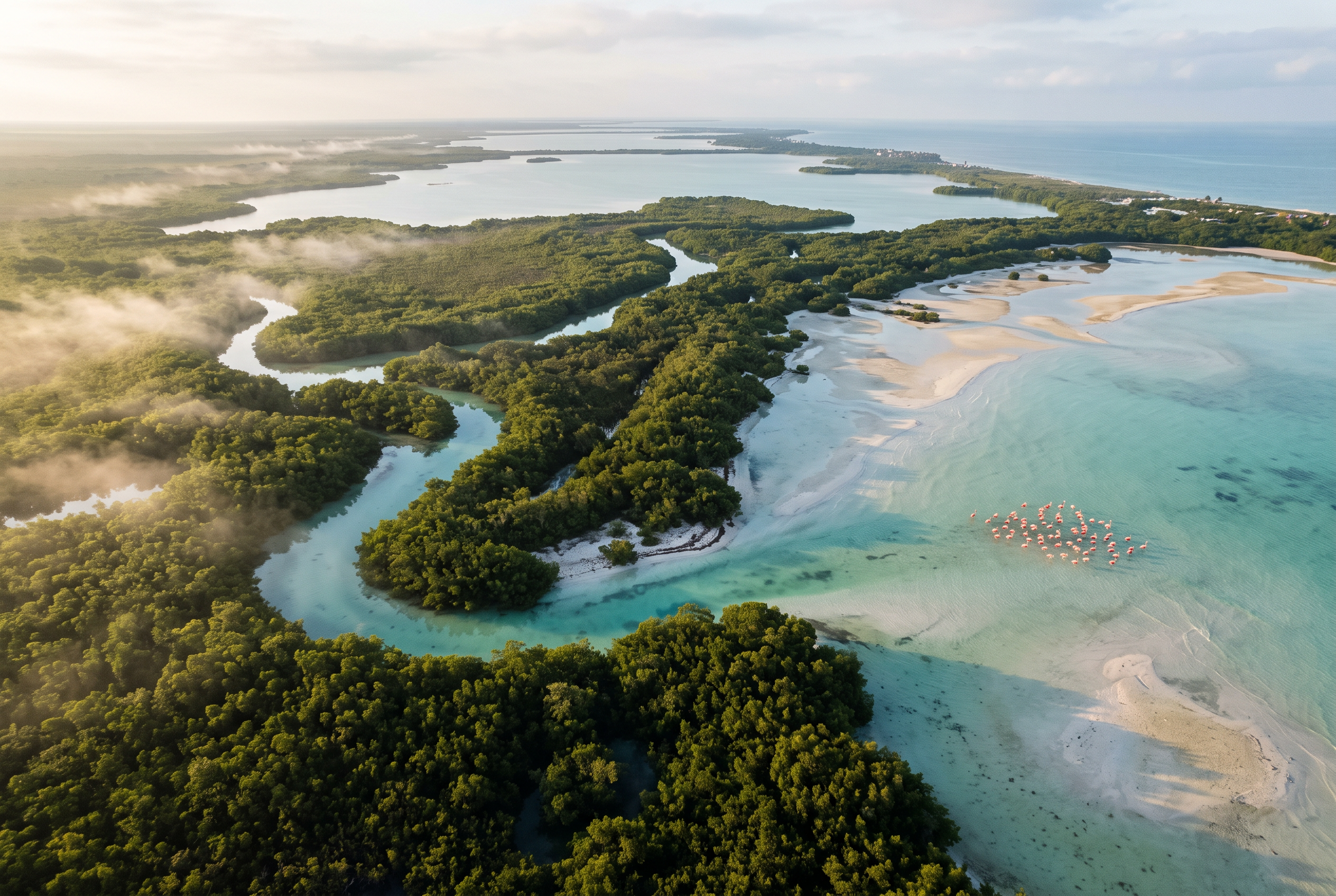
Conservation · The reserve behind the tours
Yum Balam and Holbox: why the protected area actually matters (2026)
The honest guide to Yum Balam — the 154,052-hectare Area de Protección de Flora y Fauna around Holbox. Correct legal category, subzones in plain language, what visitor rules actually exist, and the operator-authorization checks that matter.
What Yum Balam actually is
Yum Balam is more than a name on Holbox tour brochures. It’s the protected-area framework that explains why certain places can be visited in specific ways and others face much tighter limits.
Its formal legal category is Área de Protección de Flora y Fauna, usually shortened to APFF. That matters: a lot of travel content calls it a “biosphere reserve” or “national park,” and it’s neither. APFF is a Mexican category that allows regulated human activity and settlement within defined subzones, unlike the more restrictive national park designation.
Yum Balam at a glance
- Legal category
- Área de Protección de Flora y Fauna (APFF). Not a national park, not a biosphere reserve.
- Created
- June 6, 1994.
- Current management summary
- Published October 30, 2018.
- Total protected area
- 154,052.25 hectares (not just Holbox island, not just the town).
- Includes
- Mangroves, coastal lagoons, seagrasses, dunes, nesting beaches, juvenile fish habitat.
- Managing body
- SEMARNAT / CONANP (Mexico's National Commission of Natural Protected Areas).
The size and what’s in it
154,052.25 hectares is a lot of ground — about 1,540 square kilometres. The protected area wraps around and well beyond the island most visitors ever see. The management framework identifies several habitat types that do real ecological work:
- Mangroves — nursery habitat for juvenile fish, carbon storage, storm buffering.
- Coastal lagoons and seagrasses — feeding areas for manatees, turtles, flamingos, and the whale sharks the island is famous for.
- Dunes and nesting beaches — turtle nesting zones (Punta Mosquito and others). May–October closures affect visitor access.
- Freshwater features — cenotes and springs like Yalahau on the mainland side.
A view that looks pleasantly empty to a visitor is doing quite a lot of work.
Subzones: not every rule everywhere
The single most common misunderstanding about Yum Balam: people assume one rule applies to the whole protected area. The management summary divides the area into subzones with different permitted uses:
- Preservation subzones — tightest restrictions. Punta Mosquito beach and some Isla Grande beaches are in preservation subzones. Feeding wildlife, disruptive noise, and disturbance of nesting/refuge sites are prohibited in these sections. Vehicles on these beaches are restricted (with specified management-and-conservation exceptions).
- Sustainable-use subzones — regulated human activity, including some fishing and tourism operations under authorization.
- Settlement subzones — includes the inhabited town of Holbox itself. Normal community life is permitted; development is still regulated.
- Recovery subzones — areas being actively restored after past disturbance.
That’s why a rule for one location shouldn’t automatically be presented as the rule for the entire island. “All construction is forbidden in Yum Balam” and “anything goes on Holbox” are both wrong by the same mistake — treating one subzone as if it were the whole reserve.
Equally, seeing people enter a place doesn’t prove every activity is permitted there. Enforcement is uneven across 154,000 hectares.
What visitors are expected to do
The official programme’s indexed visitor obligations include:
- Respect routes, markers, signage, and zoning. Follow signs even when they’re in Spanish.
- Follow current access instructions. Temporary closures (turtle nesting, flood damage, enforcement actions) may be in force.
- Do not feed or disturb wildlife. This is a general preservation-subzone prohibition and a good universal practice elsewhere.
- Keep to designated vehicle areas. Golf carts and bikes on preservation beaches is a specific problem the rules address.
For the fuller treatment of wildlife-encounter rules — including the April 2026 enforcement action involving queen conch and starfish near Playa Azul — see Wildlife on Holbox: what to leave alone.
Tours, operators, and authorizations
Tour operators providing tourist-recreational services within Yum Balam need relevant authorizations. The specific authorization depends on the activity (whale shark observation, kayak, snorkel, 3-islands boat tour) and the subzone where the activity happens.
- Ask what authorization applies. “We’ve been doing this for years” is not an answer. A specific permit number or authorization scheme is.
- Check the operator stays in-zone. A tour sold from Holbox town may enter preservation subzones with different rules than the launching dock.
- A conservation logo isn’t a permit. “Eco-tour” branding is a marketing phrase, not a legal status.
- Report environmental concerns. If an operator is clearly breaching rules (feeding wildlife, racing boats through nesting areas, cutting mangroves), CONANP and PROFEPA (Mexico’s environmental enforcement) accept reports.
Not the same as the whale shark reserve
This trips people up. The whale shark management plan distinguishes three separate protected areas in the broader region:
Three different protected areas Holbox tours may enter
- APFF Yum Balam
- The protected area around Holbox itself. Where the island sits.
- Reserva de la Biosfera Tiburón Ballena
- A separate biosphere reserve dedicated to whale sharks. Tours from Holbox often enter this zone during whale shark season.
- Reserva de la Biosfera del Caribe Mexicano
- The northern Mexican Caribbean biosphere reserve covering a wider marine area.
A whale shark tour from Holbox is likely managed under multiple frameworks across the trip. These are not interchangeable names for the same reserve; they have different rules and different authorizing bodies. If an operator can’t explain which protected area the tour enters, that’s information.
For the whale shark season dates and operator authorization details, see the whale shark guide.
Sources and limits
This article is based on:
- SEMARNAT management agreement for Yum Balam, published via FAOLEX (signed September 28 2018, published October 30 2018).
- CONANP organizational manual with legal-instrument inventory (August 2026 indexing; confirms 1994 creation date).
- CONANP Yum Balam management programme (historical instrument; detailed search extracts only — full fetch failed).
- CONANP press announcement on Yum Balam programme protection (historical).
- SEMARNAT / DGVS whale shark management plan 2025–2027 (April 2025).
What this article is not:
- Not a legal survey or boundary map. For official subzone boundaries and closure notices, contact CONANP directly.
- Not a verified entry-fee or permit schedule. Fees and procedures change.
- Not a universal ban or permit list for pets, drones, fishing, or packaging. Rules are subzone-dependent.
- Not an endorsement of any specific tour operator.
For related reading: wildlife rules, bioluminescence, Punta Mosquito, tourism development.
Frequently asked questions
Is Yum Balam a national park?expand_more
No. Its correct legal category is Área de Protección de Flora y Fauna (APFF). It is not a national park, not a biosphere reserve, and not a marine park. The APFF category allows some human activity and settlement within defined subzones, unlike a national park which would be more restrictive.
How big is Yum Balam?expand_more
The management summary records 154,052.25 hectares for the full protected area. That is the whole APFF — not the surface area of Holbox island itself, and definitely not the surface area of the inhabited Holbox town.
When was Yum Balam created?expand_more
The APFF was created on June 6, 1994. The current management programme summary was published October 30, 2018. Older press pages sometimes show modern search-indexing dates — do not read those as "newly created in 2026." The legal instrument and the official CONANP inventory are the authoritative dates.
Is there an entry fee for Yum Balam?expand_more
This research did not verify a current entry fee, a collection point, or an official tourist map. Any price you see quoted on a travel blog may be outdated or specific to a particular tour. Confirm fees via CONANP or your authorized operator before travel; do not take a casual beach walk as proof there is no fee system.
Can my tour operator take me into the preservation subzones?expand_more
Operators providing tourist-recreational services within the APFF need relevant authorizations. The specific authorization depends on the activity (whale shark observation, kayak, snorkel, boat tour) and the subzone. Ask the operator what authorization applies to the activity and location — a logo on a brochure is not the same as a permit.
Are drones allowed in Yum Balam?expand_more
This research did not resolve current drone rules for every subzone of Yum Balam. Mexican federal aviation and protected-area rules both apply, and some protected areas require separate authorization. Default to not flying a drone over Yum Balam land or waters without specific permission in writing.
Can I take my dog to Holbox beaches inside Yum Balam?expand_more
This research did not resolve current pet-access rules for every subzone. The CONANP press material mentions pet restrictions in general terms; the management summary's preservation-zone sections prohibit disturbance of wildlife. Keep dogs leashed, away from nesting beaches, and follow signage. If you're travelling with a service animal, confirm access in writing with your hotel and tour operator.
Keep reading
Conservation · Observation over interaction
Wildlife on Holbox: what visitors should leave alone (2026)
Honest guide to Holbox wildlife rules: the April 2026 conch and starfish enforcement incident, what Yum Balam preservation rules actually prohibit, how whale shark operator authorization works, and why shells and starfish are a careful-not-casual answer.
Nocturnal wildlife · Bioluminescence
Bioluminescence on Isla Holbox: when, where, how (2026)
Honest guide to seeing bioluminescence on Isla Holbox — real season (June–October), best viewing spot (Punta Cocos mangrove channel), new-moon timing, licensed kayak tours, and what to do (and not do) to actually see the glow.
Wildlife · Whale sharks
Whale shark season Holbox 2026: complete guide
When whale sharks are actually in the water off Isla Holbox, verified tour prices, what happens on a tour, enforced Yum Balam rules, and how to pick an operator.
Natural landmark · Sandbar + wildlife
Punta Mosquito Holbox: the 2 km sandbar walk, tides, and flamingos
Honest guide to Punta Mosquito, the famous Holbox sandbar — how to walk it (low tide only), tide-window math, where the pelican colony is, why it closes May–October for turtle nesting, and what to bring.
Every guide is grounded in our verified Holbox directory and free public data feeds (Open-Meteo weather, SunCalc moon, OpenStreetMap, Google Places). Updated October 20, 2026. Independent — no paid placements in article body.