Seasons · Interpreting the occupancy numbers
How busy is Holbox? Understanding hotel occupancy and crowds (2026)
Honest answer to "is Holbox crowded?" — what the 75% summer average and 90% August peaks actually mean, what hotel occupancy does and doesn't measure, and the right booking questions to ask when choosing dates.
The short answer
Holbox can have busy weeks without being equally busy all year. The clearest 2026 figures: summer averaged about 75% hotel occupancy, with peaks around 90% in some August weeks. Those two numbers tell different parts of the story — and both get overclaimed as “Holbox is a tourism record” or “Holbox is a crowded disaster” depending on who’s writing.
Neither headline is right. This guide walks through what the figures actually mean, what they don’t measure, and the three booking questions that help you pick dates.
The 2026 summer figures
Christian Stenta, president of Holbox’s hotel association, was quoted in a September 21 2026 Quintana Roo Hoy report saying summer occupancy averaged about 75 percent, with peaks reaching 90 percent during some August weeks.
2026 Holbox summer occupancy figures (attributed)
- Summer average
- ~75% hotel occupancy (hotel association statement, September 21, 2026 reporting).
- August peaks
- Up to ~90% in some weeks.
- September 2026 forecast
- 35–40% expected (forecast from September 7 reporting, not a measured result).
- October expectation
- Quieter through mid-October, with next high season from November (September 21 reporting).
- August 19 account
- Earlier 'tourism reaches 90%' framing used a different time window; the later September average-plus-peak explanation is more precise.
What those figures establish: strong demand during parts of the summer, with enough weekly variation that “everything is full all summer” isn’t right.
What they don’t establish:
- An all-time tourism record (would need consistent prior-year series).
- That every hotel was ~90% full.
- A total visitor count (hotel occupancy ≠ visitor count).
- An ecological or infrastructure capacity breach.
What hotel occupancy actually measures
Hotel occupancy = occupied rooms ÷ available rooms, usually averaged over a period. That’s all it says.
What it doesn’t count:
- Day-trippers arriving on morning ferries from Chiquilá and leaving the same evening. These can be a huge chunk of a Playa Norte Saturday afternoon with zero hotel-occupancy impact.
- Airbnb and informal rentals that aren’t in the association’s sample.
- Ferry passengers as a crowd signal.
- Resident population.
- Beach-club foot traffic and restaurant queues.
It also depends on which hotels are in the association’s sample and how it’s calculated (daily vs weekly, room-weighted vs simple average). Those methodological details weren’t published alongside the figure. Treat the 75% average as directional, not accounting-grade.
One more trap: a 90% hotel occupancy figure says nothing directly about wastewater design capacity. Don’t connect those two numbers without the specific infrastructure data. See water and sewage for how that conversation is reported separately.
Quieter periods and what to expect
September 2026 reporting described expected lower demand through mid-October, with the next high season beginning from November. Hotels were expected to use lower demand for maintenance, improvements, and staff holidays.
That’s useful context, but it’s an expected pattern, not a guarantee for every business or future year.
Rough seasonal pattern (based on reporting + typical Caribbean cycles)
- High season
- Mid-November – April (dry season, snowbird market, holidays).
- Whale shark peak
- July – August (overlaps with hottest / rainiest months but shark demand carries August occupancy).
- Shoulder
- May – June and late September – early November. Lower demand, lower prices, higher weather risk late in the shoulder.
- Quietest
- September – early October (hurricane season peak).
- Specific caveat
- A quiet overall month can still contain a packed weekend around a Mexican national holiday. Check specific dates.
Booking questions that actually help
Instead of chasing an islandwide percentage, ask your accommodation specific questions:
- “Is any renovation or maintenance planned at the property during my stay?” — Low season = maintenance season. A “quiet” week with the pool closed isn’t the quiet week you wanted.
- “Are there local events during these dates?” — Mexican national holidays, music events, and sport fixtures spike demand.
- “What’s the sargassum / weather risk at this time?” — Occupancy can be low because conditions are harder. Shoulder season is a trade.
- “Can I shift dates if conditions are difficult?” — Flexibility costs little in low season.
- “Are the restaurants/bars I care about open?” — Some places close for maintenance in September/October.
Think about what “busy” means to you specifically. Are you trying to avoid a full hotel, a lively restaurant area, an organized event, or a queue for a particular activity? One islandwide percentage won’t answer all four.
What this guide doesn’t claim
- Not a full twelve-month occupancy chart. Only summer 2026 was in the reporting reviewed.
- Not a “cheapest month” verdict. Current comparable room prices weren’t collected.
- Not a crowd calendar. Hotel occupancy doesn’t predict beach feel.
- Not a visitor-count estimate. We’re not inventing a “X million per year” number.
- Not a prediction of future years. Patterns shift.
A broader seasonal guide — weather, sargassum, water temperature — is a separate project. See best time to visit Holbox for the companion piece.
Sources and limits
- Quintana Roo Hoy / Ángel Canul, September 21 2026 — hotel association summer occupancy report.
- La Fuente QR, September 7 2026 — September occupancy forecast.
- Quinto Poder QRP, August 19 2026 — earlier “90%” account (promotional municipal-style framing).
- Ruptura360 / Raúl Balam, October 3 2026 — low-tourism-plus-flooding reporting.
For related reading: best time to visit, how many days do you need, tourism development, Airbnb vs hotel, whale shark season.
Frequently asked questions
Is Holbox crowded in summer?expand_more
Reported 2026 summer occupancy averaged about 75%, with peaks around 90% in some August weeks (per Christian Stenta, Holbox hotel association president, in September 2026 reporting). That is strong demand during the season but it is not "every hotel was 90% full all summer." It is also not an all-time record — comparable prior-year series weren't published alongside it.
When is Holbox NOT crowded?expand_more
September reporting expected a quieter period through mid-October, with the next high season beginning from November. One September 7 forecast projected 35–40% occupancy. That was a forecast, not a measured outcome. Shoulder months (May–June and late September–early November) are typically your best shot at fewer people — but check your specific dates with your accommodation.
What's the cheapest month to visit Holbox?expand_more
This guide deliberately does not name a "cheapest month" because current comparable room prices were not collected. Travel blogs that confidently name one are usually guessing. Expect lower prices in the quieter shoulder months, but confirm with hotels directly for your dates.
Is 90% hotel occupancy the same as "the island is at capacity"?expand_more
No. Hotel occupancy measures accommodation use. It doesn't count day-trippers, ferry passengers, residents, or beach visitors who stayed in Cancún overnight. It also doesn't measure wastewater capacity, water-supply capacity, or ecological carrying capacity — those are different conversations with different data.
How many visitors does Holbox get per year?expand_more
An annual visitor count wasn't established in the research we reviewed. Hotel occupancy percentages, ferry-passenger counts, and day-trip totals are all different numbers measured in different ways. Beware of a confident "X million visitors per year" claim without a dated source behind it.
If occupancy is 90% can I still find a last-minute room?expand_more
Harder, not impossible. Peak August weeks are the tightest. Mid-week availability tends to be better than Friday–Sunday. Smaller guesthouses and Airbnbs sometimes have gaps the big-site search misses — try WhatsApping a property directly. See the Airbnb vs hotel guide for comparison.
Will I actually feel the crowds?expand_more
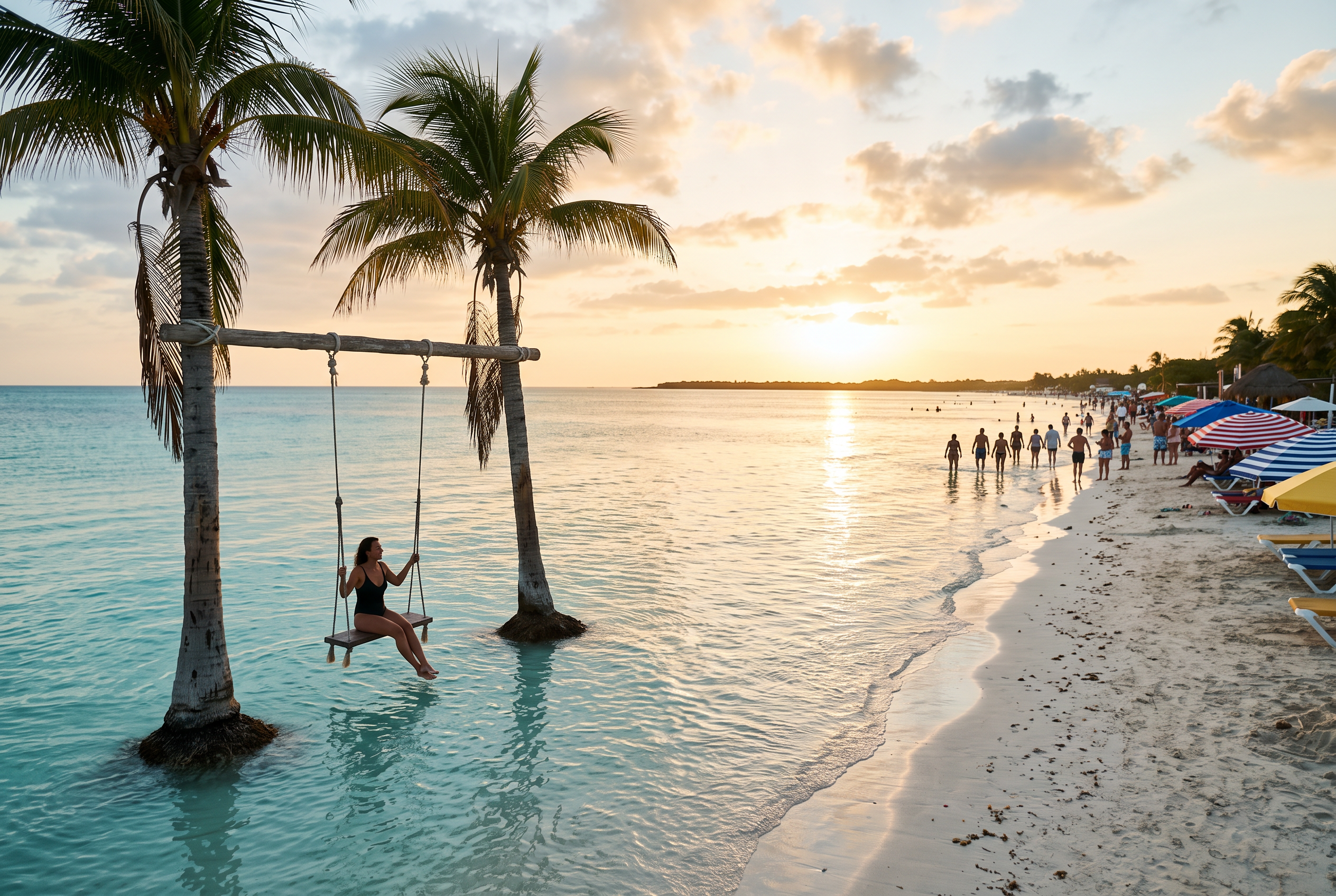
Depends on what "crowded" means to you. Playa Norte at sunset in August can feel busy; the north side of the island two kilometres further out can feel empty on the same day. Occupancy percentages don't predict the vibe at a specific beach club at 7pm on a specific Saturday. Expect busy sunsets, less-busy mornings, and quieter weekdays.
Keep reading
Development · What is proposed vs what is built
Holbox tourism growth: what's actually changing on the island (2026)
Honest look at Holbox tourism development: the 75% summer occupancy figure in context, the 1.5 billion peso infrastructure proposal, the ejidatario land-rights debate, and the Yum Balam rules behind the headlines. No "paradise lost" overcl aims; no "nothing to see here" either.
Where to stay · Airbnb vs hotel
Isla Holbox Airbnb vs hotel (2026): which to book + which zone
Honest Isla Holbox Airbnb vs hotel comparison — which neighbourhoods to book in, zone-by-zone USD/night prices, cleaning-fee math, and when a direct-booking boutique hotel beats Airbnb. 2026 prices + scam patterns to avoid.
Wildlife · Whale sharks
Whale shark season Holbox 2026: complete guide
When whale sharks are actually in the water off Isla Holbox, verified tour prices, what happens on a tour, enforced Yum Balam rules, and how to pick an operator.
Every guide is grounded in our verified Holbox directory and free public data feeds (Open-Meteo weather, SunCalc moon, OpenStreetMap, Google Places). Updated October 20, 2026. Independent — no paid placements in article body.