Infrastructure · What is confirmed, what is not
Holbox water and sewage: what visitors should actually know (2026)
Honest look at Holbox water and sewage: the 1.5 billion peso drainage proposal, March 2026 aqueduct repair, drinking-water precautions, and the specific questions to ask your accommodation before you book.
The short answer
Holbox has had documented water-supply interruptions and known pressure on its wastewater infrastructure. The island’s mayor called for a major investment in April 2026. These are related public-service concerns, but they are not one big ongoing breakdown, and nothing in the public reporting establishes that the island is “without water” today.
The useful framing for a visitor isn’t cancel-or-not. It’s: understand the two separate systems, know what a reasonable question to your accommodation looks like, and follow the normal Mexico rule about tap water. The specific numbers below are attributed to the reports they come from, with the date qualifications intact.
Water supply vs sewage: separate systems
Before any of the figures make sense, these have to be unbundled. A leaking drinking-water pipe and an overloaded sewage system are not the same incident, and a flooded road isn’t automatically a sewage overflow.
Four separate things people call 'the water problem'
- Drinking water supply
- Mainland wells, pumping, and an aqueduct deliver fresh water to Holbox. CAPA is the operator. A leak or power failure here means low pressure or no flow from the tap.
- Wastewater and sanitary drainage
- The vacuum drainage network and treatment arrangements that carry sewage away from properties. The April 2026 proposal was aimed at this layer.
- Rainwater and street flooding
- Heavy rain floods streets. That's a different system (or lack of one) and is not evidence of a sewage overflow unless specifically confirmed.
- Property-level setup
- Each hotel, Airbnb, or hostel has its own storage tanks, pumps, water heater, and sometimes a generator. These vary enormously. We did not inspect any specific property.
The 1.5 billion peso proposal
The attributed estimate: In April 2026 reporting, Mayor Nivardo Mena Villanueva said Holbox needed at least 1,500,000,000 Mexican pesos for a comprehensive drainage and wastewater-management project. The same report said accelerated growth had overwhelmed the existing system.
A few things to keep straight:
- Pesos, not dollars. The figure gets quoted in English without a currency label and sometimes rendered as “$1.5 billion.” At late-2026 rates, 1.5 billion pesos is roughly 75–85 million USD — still a big investment proposal, nowhere near a US-billion-dollar project.
- A proposal is not an approved budget. The April report said the proposal had been presented to Conagua. There was no set implementation date at that time, and we didn’t find a document establishing that the full scheme has been funded, awarded to a contractor, or started construction.
- What it’s meant to fix: The mayor’s framing is that current drainage and wastewater handling isn’t keeping up with the number of hotels, restaurants, and visitors the island now has. That’s an attributed political statement, not an independent capacity measurement.
Earlier March 2026 reporting attributed a similar figure to the mayor with a broader headline that included drinking water, drainage, and sewerage. The April coverage is the fuller account and the one quoted above. If and when a procurement notice, award, or construction schedule becomes public, this article should be updated to reflect it — not before.
The March 2026 aqueduct repair
The best-documented single incident this year was a drinking-water supply interruption around early March 2026. According to reporting based on CAPA’s updates:
- Electrical problems affected the mainland wells supplying the island.
- A substantial aqueduct leak was identified and required repair, including underwater work.
- The reporting said those repairs had been completed and pumping had restarted, with network pressure gradually recovering.
Two useful takeaways from that. First, there is a documented history of outage — infrastructure on Holbox is not maintenance-free, and a repeat is possible. Second, the March headline doesn’t mean the identical leak is still open today. We’ve seen that line copy-pasted into October travel pieces as if it were current news; it isn’t.
An earlier January 2026 report also described maintenance on the island’s vacuum drainage network, with municipal support and CAPA personnel involved. That’s evidence that work is ongoing, not proof that every drainage problem has been resolved.
Rain, flooding and roads
An October 3 regional report described torrential-rain impacts on Holbox roads. On a flat sandy island with limited stormwater drainage, heavy rain means standing water and, for a while, difficult road conditions — particularly on the route from the ferry pier through town. That’s a traffic and comfort problem more than a sewage problem.
What that means practically:
- In the June–October rainy months, check conditions with your accommodation the day before you travel, especially if you’re arriving at night or carrying a lot of luggage.
- A puddle on the main street during a downpour is not, by itself, evidence of raw sewage. Don’t swim through it either way.
- Golf carts handle wet sand fine; they handle deep standing water badly. If a specific stretch is flooded, walk or wait.
Is the tap water safe to drink?
No, and this is not a Holbox-specific finding. The US CDC advises travellers not to consume tap water in Mexico, as a country-level precaution. Canada’s travel-health guidance recommends boiled or disinfected water or commercially sealed bottled water, ice made from purified water, and purified or bottled water for brushing teeth.
That applies on Holbox the same way it applies in Mexico City, Tulum, or Playa del Carmen. The island doesn’t have a certification system that would let an individual property say “our tap water is safe to drink.” A property offering a refill station or filtered dispenser is useful; just ask how it’s sourced and treated rather than assuming the word “filtered” answers every question.
Simple rules that work
- Drinking
- Bottled water. Many accommodations provide 5-gallon purified refills.
- Brushing teeth
- Bottled or purified water (easy habit to miss on day one).
- Ice
- Only from established restaurants and bars — they typically use purified-water ice. Street-vendor ice is a gamble.
- Showering
- Fine. Try not to swallow it.
- Cooking
- Fine for boiled water (pasta, coffee, etc.). Rinsing salad: use purified or peel it.
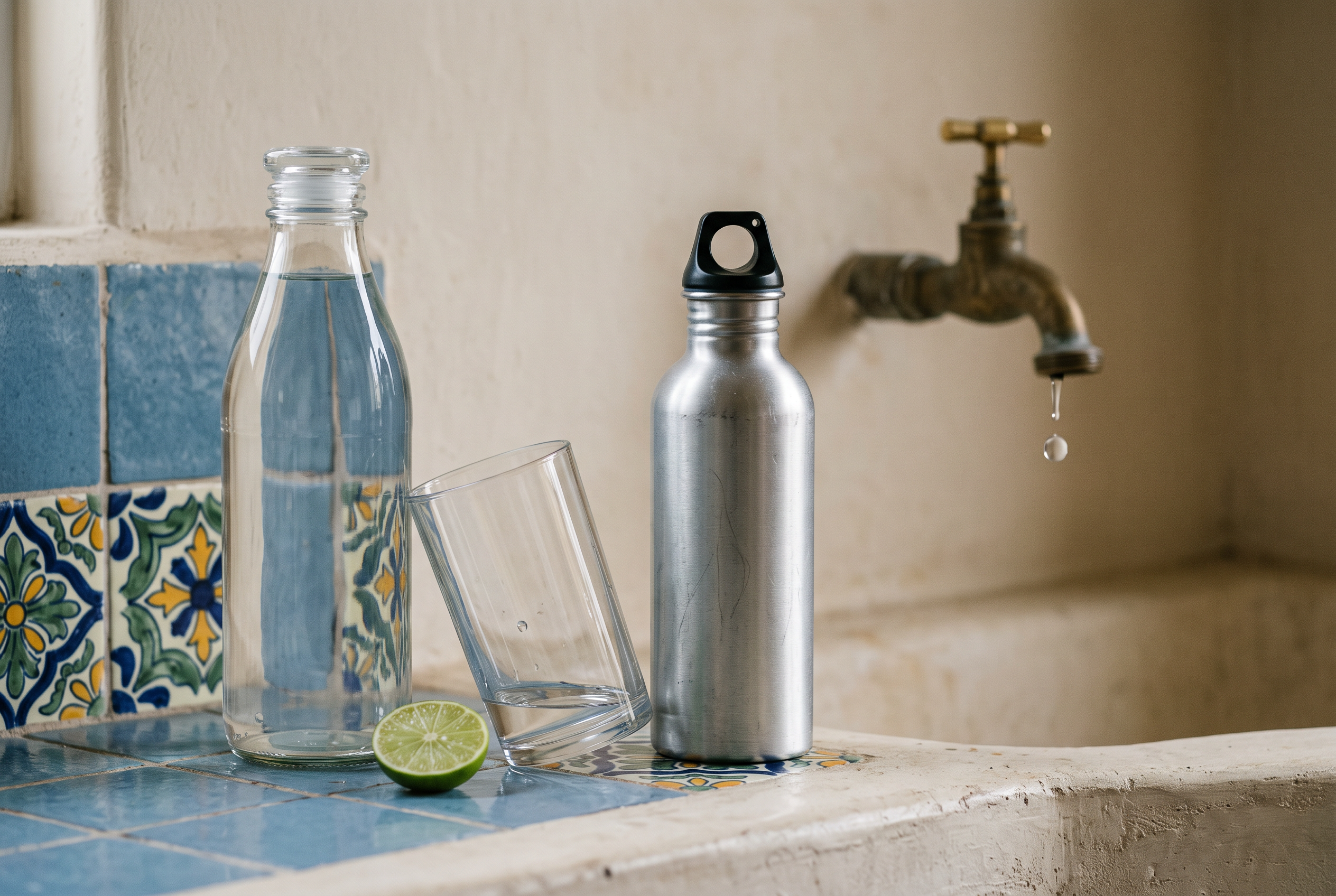
Pack a reusable bottle; most hotels and some restaurants will refill it at no cost. See the Holbox packing list for what else travels well on the island.
What to ask before you book
These are the questions that actually produce useful answers. Message your accommodation directly — by email or WhatsApp, so you have the reply in writing:
- Have you had any water interruption in the last seven days? Specific and recent beats vague reassurance.
- Is water currently available in all guest rooms? The honest answer sometimes is “yes, with a cistern that gets topped up overnight.” That’s a fine answer.
- Do you have a water storage tank, and what services does it support during an interruption? (Showers, flushing, pool, kitchen.)
- Is a power outage likely to cut off your pumps? On Holbox, electricity and water are tightly coupled.
- What drinking water do you provide guests, and how is it sourced?
- Have recent rains affected the route from the ferry to the property? Especially useful in September and October.
- How do you notify guests if water or access conditions change? WhatsApp group? Front desk only? Nothing?
- If an essential service fails during my stay, what are your alternative arrangements and booking terms?
A good host will answer most of these in a sentence or two. A host who dodges every one of them is telling you something useful.
Sources and limits
This article draws on English and Spanish reporting about the April 2026 drainage proposal, CAPA’s March aqueduct update, local maintenance coverage from January 2026, Quintana Roo rain reporting from October 2026, and country-level travel-health guidance from the US CDC (Yellow Book, Mexico, 2026 edition) and the Government of Canada.
What this article is not:
- Not an on-the-ground engineering inspection.
- Not a current laboratory analysis of any specific water source on the island.
- Not a verified contact list for CAPA or Conagua. Confirm phone numbers and current dialling formats before relying on them.
- Not an endorsement or warning about any individual property.
- Not an argument that the entire wastewater problem is already fixed, or that nothing is being done.
If a procurement document, project award, construction schedule, or official water-quality monitoring report becomes publicly available, this page should be updated to say so — with the new date, not just a refreshed timestamp. If you spot something that’s changed, we’d rather update the page than leave a stale number up.
For related trip planning, see is Holbox safe?, medical care on Holbox, and the live Holbox conditions page.
Frequently asked questions
Does Holbox have working water and sewage right now?expand_more
As of the research cutoff on 20 October 2026, there is no verified source saying the island is currently without water or that sanitation has collapsed. The clearest documented event this year was a March aqueduct and electrical repair that CAPA (Quintana Roo's water utility) said had been completed with pressure recovering. That is not a promise there will never be another interruption — ask your accommodation about the last seven days before you arrive.
What is the 1.5 billion peso figure I keep seeing?expand_more
In April 2026 reporting, Mayor Nivardo Mena Villanueva said Holbox needed at least 1.5 billion Mexican pesos (not US dollars) for a comprehensive drainage and wastewater-management project. The April report said the proposal had been presented to Conagua, Mexico's National Water Commission, and that there was no set implementation date at that time. It is a proposal, not a confirmed loss or an approved budget.
Can I drink the tap water on Holbox?expand_more
No. The US CDC advises travellers not to consume tap water in Mexico. Canada's travel-health guidance recommends boiled or disinfected water, or commercially sealed bottled water, including purified ice and purified or bottled water for brushing teeth. This is general national-level advice and applies on Holbox the same way it applies anywhere else in Mexico.
Are the beaches contaminated?expand_more
There is no verified islandwide monitoring result in the material we reviewed that would support saying "all beaches are polluted." Reports of pressure on the sewage system raise real environmental questions, but they are not the same as a measured contamination finding. If a specific beach has a boil-water or closure notice posted when you arrive, follow it.
What was the aqueduct leak in March 2026?expand_more
Based on reporting that cites CAPA, electrical problems affected mainland wells supplying Holbox, and an aqueduct leak also required repair, including underwater work. The report said those repairs had been completed and pumping had restarted, with network pressure gradually recovering. Treat the March incident as a documented past event, not an ongoing outage.
Do hotels have backup water if the supply fails?expand_more
Some do, some don't. Our research did not verify the storage, pumping, treatment, or generator arrangements at any specific property. If a reliable water supply matters to you — for a longer stay, for medical reasons, for travel with young kids — ask the property directly before booking and get the answer in writing.
Should I cancel my trip because of water or sewage?expand_more
The evidence does not support cancelling a Holbox trip over infrastructure concerns at the time of writing. It supports being an informed guest: use bottled or filtered water for drinking and teeth brushing (the normal Mexico rule), ask your accommodation specific questions about recent interruptions, and travel with normal reserves of patience in case a repair happens during your stay.
What does CAPA stand for?expand_more
Comisión de Agua Potable y Alcantarillado — Quintana Roo's state drinking-water and sewage utility. CAPA is the operator typically referenced in reports about water supply, aqueduct repairs, and drainage work on Holbox. Conagua is the separate federal body (National Water Commission) that reviews larger infrastructure proposals.
Keep reading
Health · Emergency numbers and planning
Medical care on Holbox: clinics, emergencies and what to expect (2026)
Honest guide to medical care on Isla Holbox: the January 2026 health-centre expansion, how to call 911 in Mexico, what the island has (and doesn't have), travel-insurance preparation, and the right questions before you need help.
Safety · Honest 2026
Is Isla Holbox safe? Honest 2026 safety guide
Honest safety breakdown for Isla Holbox — cartel presence (none), US State Dept travel advisory level, solo female traveller reports, scam patterns at Chiquilá ferry, real risks (dengue, rip currents, jellyfish), and night-walking by neighbourhood.
Trip planning · Packing
Isla Holbox packing list (2026): what to actually bring
A no-fluff packing list for Isla Holbox — reef-safe sunscreen for bioluminescence tours, DEET for mangrove mosquitoes, cash because many spots don’t take cards, waterproof shoes for sand streets after rain. What to pack by season.
Every guide is grounded in our verified Holbox directory and free public data feeds (Open-Meteo weather, SunCalc moon, OpenStreetMap, Google Places). Updated October 20, 2026. Independent — no paid placements in article body.